Grade 10 Physical Sciences · Matter and Materials · Paper 2 (Chemistry)
Chemical Bonding Grade 10
Real Chemical Bonding past paper questions and answers from 2018 to 2024, with each memo split into the ticks examiners give. Try one, mark yourself, and see exactly which skill cost you marks.
- past paper questions
- 84 past paper questions
- skills
- 4 skills
- videos
- 4 videos
Try a Chemical Bonding exam question
No sign-up. Takes 3 minutes.
Question 1.6 · November 2019 · Paper 2 · National (DBE) · 2 marks
Work it out on paper first. Then mark yourself with the official memo, one tick at a time.
Chemical Bonding skills
Each skill is one thing a memo gives a tick for. Tap one for its own questions, notes and videos.
- Write names and formulae of compoundsWrite the formula of a compound from its name, or the name from its formula (sodium chloride is NaCl).23 past paper questions · 4 videos
- Define bonding and intermolecular termsGive the exact meaning of bonding words like covalent bond, ionic bond, lone pair, electronegativity and bond energy.62 past paper questions · 4 videos
- Draw Lewis diagramsDraw Lewis dot diagrams showing valence electrons, shared pairs and lone pairs (water has two bonding pairs and two lone pairs).40 past paper questions · 3 videos
- Identify and compare chemical bondsName a bond as covalent, ionic or metallic and describe how it forms (electrons are shared in a covalent bond, as in H₂).73 past paper questions · 4 videos
More Chemical Bonding Grade 10 questions and answers
Try each one on paper before you open the memo.
4. Question 2.1.1 · November 2019 · Paper 2 · National (DBE) · 2 marks
Most elements found on Earth are metals. All metals have a metallic structure.2.1 For a metallic structure, write down the:2.1.1 Type of particles present(2)Show the memo (2 ticks)Memo
- ✓Positive ionsPositive ions
1 mark · Identify and compare chemical bonds
- ✓Delocalised electronsDelocalised valence electrons
1 mark · Identify and compare chemical bonds
- ✓
5. Question 1.4 · November 2024 · Paper 2 · Provincial · 2 marks
1.4 In which ONE of the following compounds do covalent bond occur between elementary particles?(2)Show the memo (1 tick)Memo
- ✓Correct optionAmmonia, , is a compound of two non-metals, so its atoms share electrons in covalent bonds. Sodium chloride is ionic, mercury is metallic, and carbon is an element, not a compound.
Answer: C2 marks · Identify and compare chemical bonds
- ✓
6. Question 2.1.5 · November 2024 · Paper 2 · Provincial · 2 marks
2.1 In the table below are different substances.
Use the following substances to answer the questions that follow.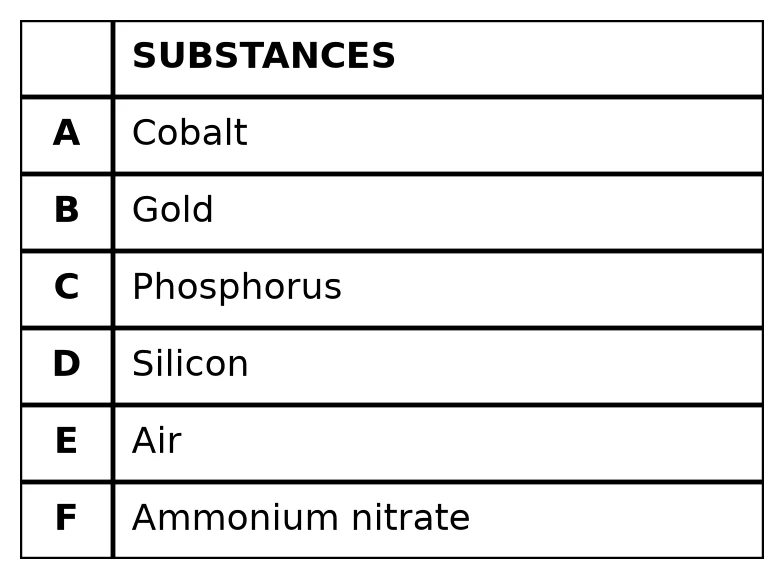 2.1.5 Write down the chemical formula for substance F (Ammonium nitrate).(2)
Show the memo (1 tick)Memo
- ✓Formula of ammonium nitrate
2 marks · Write names and formulae of compounds
- ✓
7. Question 1.3 · June 2024 · Paper 2 · Provincial · 2 marks
Various options are provided as possible answers to the following questions. Each question has only ONE correct answer. Choose the answer and write only the letter (A–D) next to the question numbers (1.1 to 1.5) in the ANSWER BOOK, e.g. 1.6 C.1.3 In which ONE of the following compounds do metallic bond occur between elementary particles?(2)Show the memo (1 tick)Memo
- ✓Correct optionMetallic bonding occurs only between metal atoms. Mercury is a metal (a liquid one). Sodium chloride is ionic, water has covalent bonds and sulphur is a non-metal with covalent bonds.
Answer: B2 marks · Identify and compare chemical bonds
- ✓
8. Question 3.3.2 · June 2024 · Paper 2 · Provincial · 2 marks
Chlorine is a non-metallic element with an atomic number of and can exist as isotopes.3.3 Calcium reacts with chlorine to form calcium chloride.
Answer the questions that follow.3.3.2 Write down the chemical symbols of the particles found in the calcium chloride crystal (lattice).(2)Show the memo (2 ticks)Memo
- ✓Calcium ion
1 mark · Identify and compare chemical bonds
- ✓Chloride ion
1 mark · Identify and compare chemical bonds
- ✓
9. Question 1.1 · November 2023 · Paper 2 · Provincial · 2 marks
Four options are provided as possible answers to the following questions. Each question has only ONE correct answer. Choose the answer and write only the letter (A–D) next to the question numbers (1.1 to 1.9) in the ANSWER BOOK, e.g. 1.10 D.1.1 Which of the following solids consist of a lattice of positive ions in a "sea" of delocalised electrons?(2)Show the memo (1 tick)Memo
- ✓Correct optionPositive ions in a sea of delocalised electrons is the description of METALLIC bonding. Potassium is the only metal. Ice and iodine are molecular solids (molecules held by intermolecular forces), and diamond is a covalent network solid.
Answer: D2 marks · Identify and compare chemical bonds
- ✓
10. Question 3.1 · November 2023 · Paper 2 · Provincial · 2 marks
The grade 10 learners conducted an experiment to investigate the effect of the increase in temperature on ethanol over a period of time at standard pressure.
The graph below was drawn using the results obtained.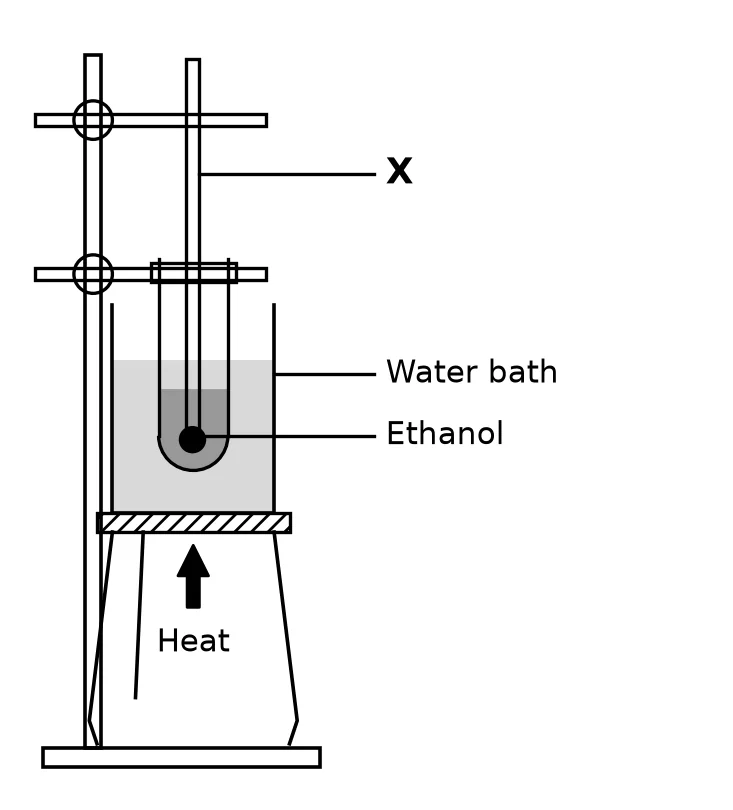
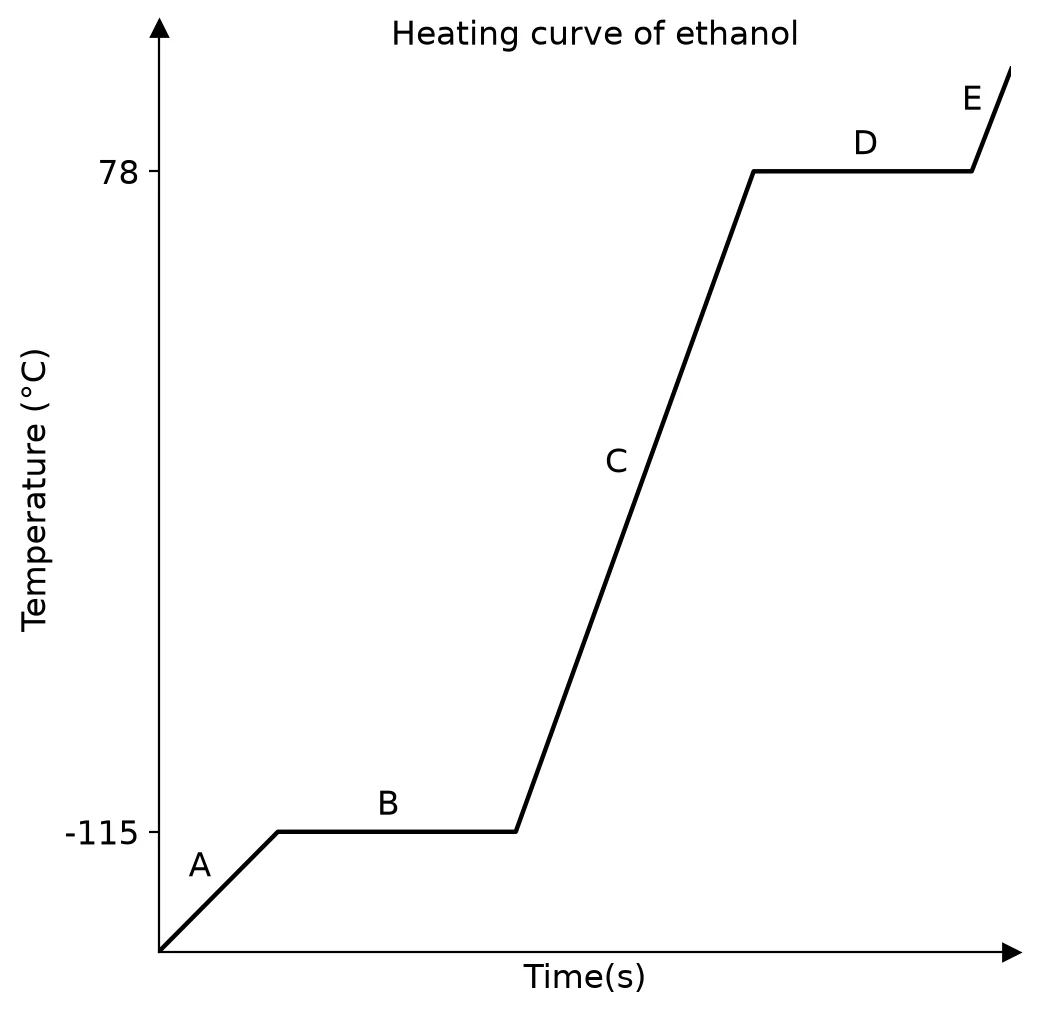 3.1 Define the term melting point.(2)
Show the memo (1 tick)Memo
- ✓Definition of melting pointThe temperature at which a solid, given sufficient heat, becomes a liquid.
2 marks · Define bonding and intermolecular terms
- ✓
Chemical Bonding Grade 10 videos
Short lessons from South African teachers first. Videos load only when you tap play, to save your data.
Free on Android
Know exactly which skill is costing you marks.
Mark past papers tick by tick in the NavyBlue app. It remembers every mark you lose, shows you the skills to fix first, and picks your next questions.
Get NavyBlue free on Google Play
