Grade 10 Physical Sciences · Waves, Sound and Light · Paper 1 (Physics)
Transverse Pulses Grade 10
Real Transverse Pulses past paper questions and answers from 2017 to 2024, with each memo split into the ticks examiners give. Try one, mark yourself, and see exactly which skill cost you marks.
- past paper questions
- 29 past paper questions
- skills
- 2 skills
- videos
- 2 videos
Try a Transverse Pulses exam question
No sign-up. Takes 3 minutes.
Question 1.6 · November 2019 · Paper 1 · National (DBE) · 2 marks
Work it out on paper first. Then mark yourself with the official memo, one tick at a time.
Transverse Pulses skills
Each skill is one thing a memo gives a tick for. Tap one for its own questions, notes and videos.
- Define wave termsGive the exact meaning of wave words like amplitude, wavelength, frequency, period, crest and compression.17 past paper questions · 4 videos
- Apply superposition of pulsesAdd two pulses that meet to find the combined pulse, and say if the interference is constructive or destructive (two 2 cm crests make 4 cm).13 past paper questions · 3 videos
More Transverse Pulses Grade 10 questions and answers
Try each one on paper before you open the memo.
4. Question 6.1 · November 2017 · Paper 1 · National (DBE) · 3 marks
Two girls, standing at opposite ends of a rope, each makes a pulse of the same speed. Pulse A, with an amplitude of cm, moves to the right and pulse B, with an amplitude of cm, moves to the left. The pulses meet at point C.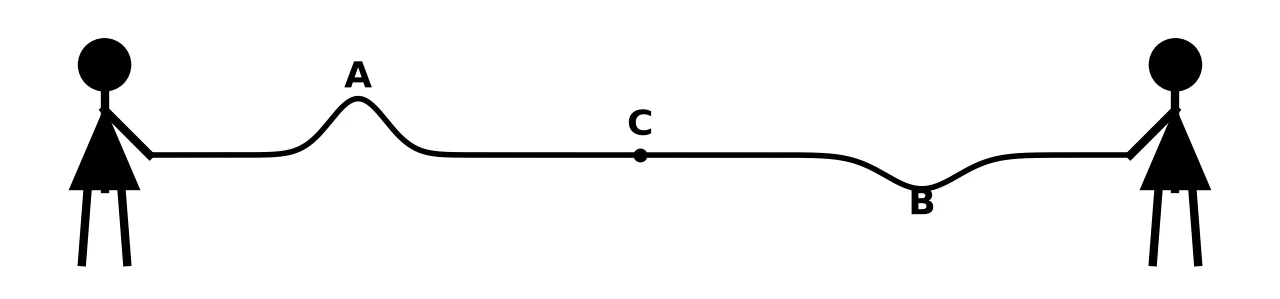 6.1 State the phenomenon observed when the two pulses meet at point C.(3)
Show the memo (2 ticks)Memo
- ✓Name of the phenomenonSuperposition of pulses.
1 mark · Apply superposition of pulses
- ✓Description of superpositionAlgebraic sum of the amplitudes of two pulses that occupy the same space at the same time.
2 marks · Define wave terms
- ✓
5. Question 1.1 · June 2024 · Paper 1 · Provincial · 2 marks
Four options are provided as possible answers to the following questions. Each question has only ONE correct answer. Choose the answer and write only the letter (A–D) next to the question number (1.1–1.5) in the ANSWER BOOK, for example 1.6 E.1.1 Pulse A, moving to the right, with an amplitude of Y metres overlaps with Pulse B, moving to the left, with an amplitude of ½ Y metres, as shown in the diagram below.
Which of the following combinations will be CORRECT when the pulses meet at the same point in the medium?(2)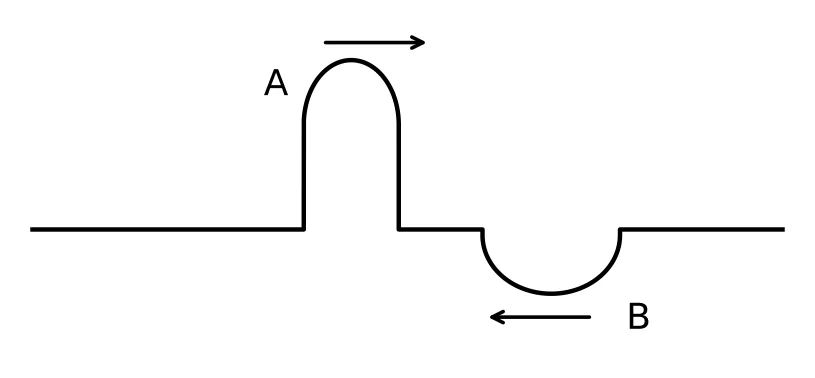
Show the memo (1 tick)Memo
- ✓Correct optionPulse A is a crest (upwards) and pulse B is a trough (downwards), so when they meet they cancel partly: this is destructive interference.
The resultant amplitude is the difference of the two amplitudes: .
Answer: D2 marks · Apply superposition of pulses
- ✓
6. Question 2.1 · June 2024 · Paper 1 · Provincial · 2 marks
The diagram below represents a transverse wave of frequency Hz, moving from left to right at a speed of m·s.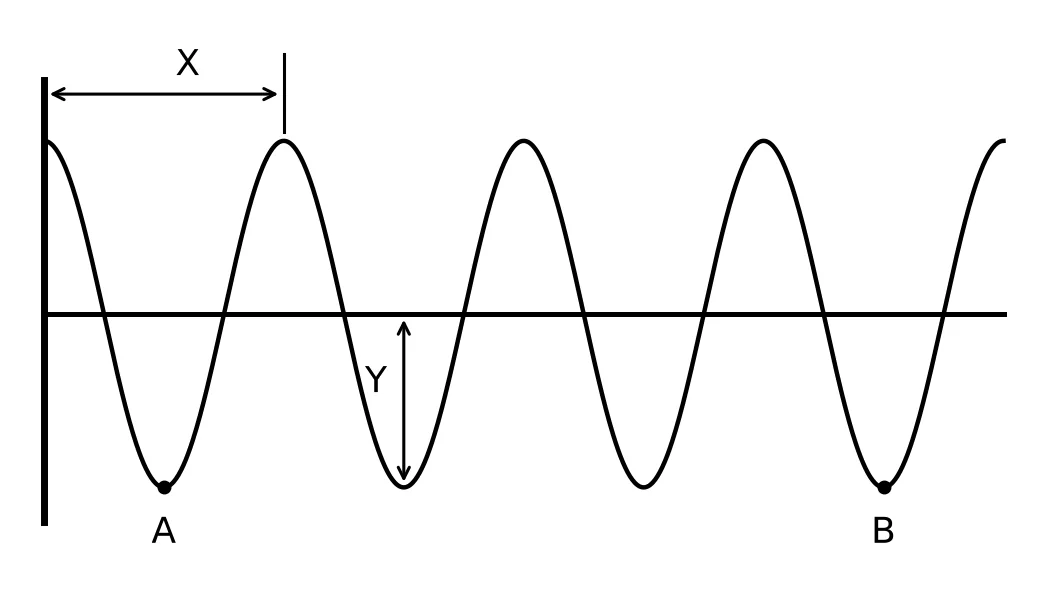 2.1 Define the term transverse wave in words.(2)
Show the memo (2 ticks)Memo
- ✓Particles vibrate at right anglesA wave in which the particles of the medium vibrate at right angles
1 mark · Define wave terms
- ✓To the direction of motion of the waveto the direction of the motion of the wave.
1 mark · Define wave terms
- ✓
7. Question 1.1 · June 2024 · Paper 1 · Provincial · 2 marks
1.1 Which of the following best defines a transverse wave?(2)Show the memo (1 tick)Memo
- ✓Definition of a transverse waveIn a transverse wave the particles of the medium vibrate at right angles (perpendicular) to the direction in which the wave moves. Particles moving parallel to the direction of motion describe a longitudinal wave.
Answer: B2 marks · Define wave terms
- ✓
8. Question 2.1 · June 2024 · Paper 1 · Provincial · 2 marks
A snapshot of a transverse wave is given below, the wave has a frequency of Hz and is moving from left to right.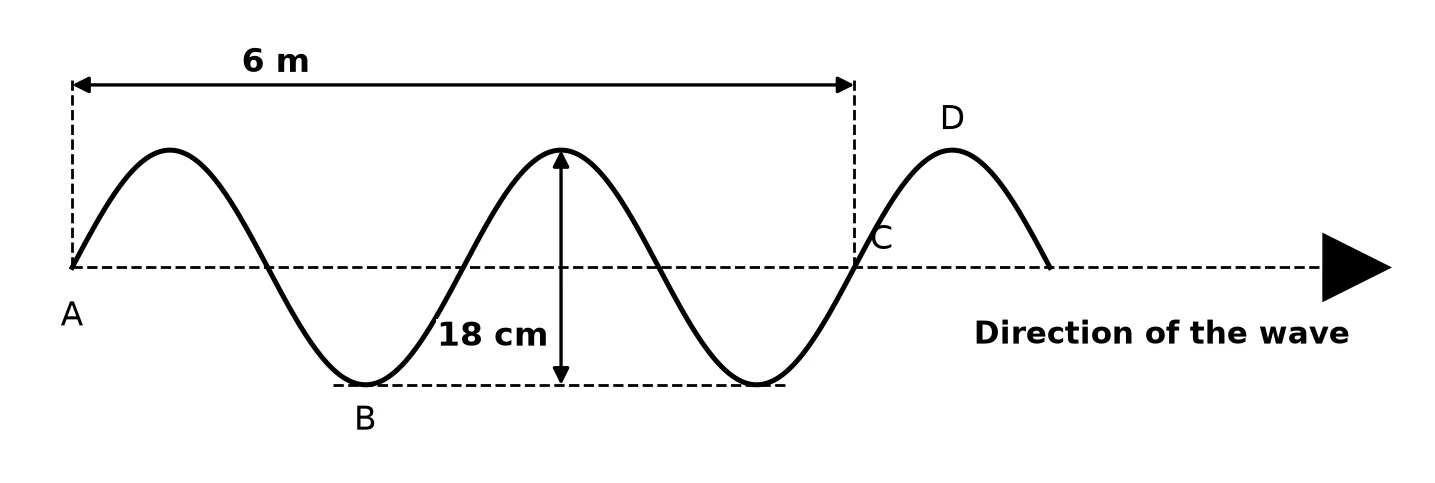 2.1 Define the term frequency.(2)
Show the memo (2 ticks)Memo
- ✓Number of wavesThe number of waves/wave pulses
1 mark · Define wave terms
- ✓Per secondpassing a point per second.
1 mark · Define wave terms
- ✓
9. Question 1.1 · November 2023 · Paper 1 · Provincial · 2 marks
1.1 The maximum displacement of a particle from its equilibrium position is ...(2)Show the memo (1 tick)Memo
- ✓Identify the term definedAmplitude is defined as the maximum displacement of a particle from its position of rest (equilibrium position). Wavelength is a distance between two successive points in phase, not a displacement from equilibrium.
Answer: B2 marks · Define wave terms
- ✓
10. Question 2.1 · November 2023 · Paper 1 · Provincial · 2 marks
The diagram below represents a transverse wave with the frequency of Hz moving from left to right.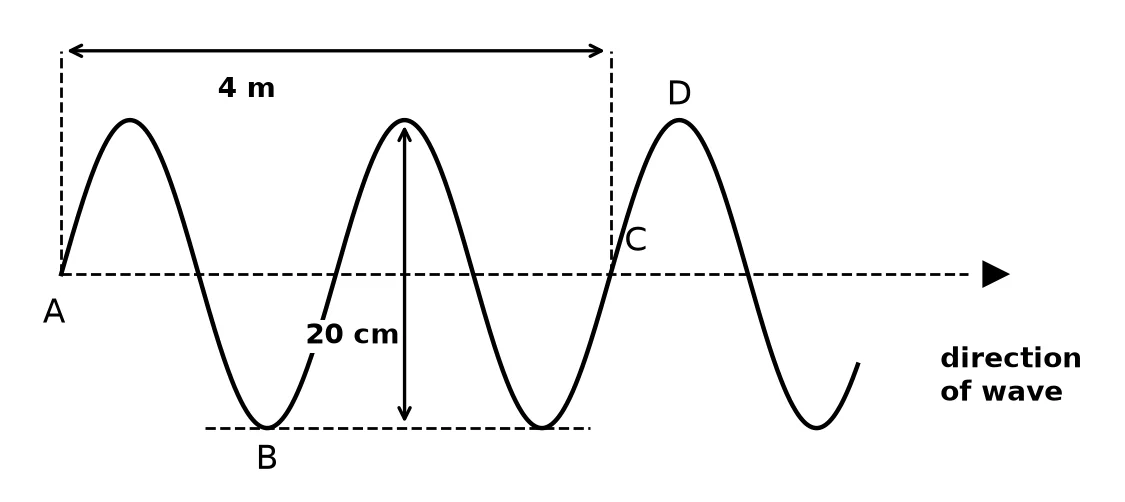 2.1 Define a transverse wave.(2)
Show the memo (1 tick)Memo
- ✓Definition of a transverse waveA transverse wave is a wave in which the particles of the medium vibrate at right angles to the direction of the motion of the wave.
2 marks · Define wave terms
- ✓
Transverse Pulses Grade 10 videos
Short lessons from South African teachers first. Videos load only when you tap play, to save your data.
Free on Android
Know exactly which skill is costing you marks.
Mark past papers tick by tick in the NavyBlue app. It remembers every mark you lose, shows you the skills to fix first, and picks your next questions.
Get NavyBlue free on Google Play
